Showing posts with label History. Show all posts

Thursday, April 7, 2011

Chhota Imambara


Chhota Imambara (छोटा इमामबाड़ा), also known as Hussainabad Imambara is an imposing monument located in the city of Lucknow, Uttar Pradesh, India. Built by Muhammad Ali Shah, The third Nawab of Avadh in 1838, it was to serve as his own mausoleum. It is also known as the Palace of Lights because of its decorations during special festivals.
The chandeliers used to decorate the interior of this building was brought from Belgium. Thousands of labourers worked on the project to gain famine relief.
It has a gilded white dome and several turrets and minarets. The tombs of Muhammad Ali Shah and other members of his family are inside the imambara. The walls are decorated with Arabic calligraphy.
Outside the imambara is the watch tower called Satkhanda or tower of seven storeys. Though it is called satkhanda, it has only four storeys, as the construction of the tower was abandoned when Ali Shah died. satkhanda is built between 1837-1842 in the time of mohammad ali shah. mohammad ali shah wanted to made it same as kutubmeenaar of delhi and leaning tower of pisa.the main purpose of this construction is moon watching.

Bara Imambara


Bara Imambara

Bara Imambara (बड़ा इमामबाड़ा) is an imambara complex in Lucknow, India, built by Asaf-ud-daulah, Nawab of Lucknow, in 1784. It is also called the Asafi Imambara.
Bara means big, and an imambara is a shrine built by Shia Muslims for the purpose of Azadari. The Bara Imambara is among the grandest buildings of Lucknow.
The complex also includes the large Asfi mosque, the bhulbhulayah (the labyrinth), and bowli, a step well with running water. Two imposing gateways lead to the main hall.

The Bara Imambara was built in 1783, a year of a devastating famine, and one of Asaf-ud-Daula's objectives in embarking on this grandiose project was to provide employment for people in the region. According to reports, the famine continued for over a decade and the construction of the building continued for this time. It is said that ordinary people used to work in the day building up the edifice, while noblemen and other elite were called at night to break down all the structure raised, as they were incapable of doing anything else, according to a chronicle of the period. This see-saw efforts continued till the famine period was over. It was a project that preceded a Keynesian like intervention for employment generation.

The architecture of the complex reflects the maturation of ornamented Mughal design, namely the Badshahi Mosque - it is one of the last major projects not incorporating any European elements or the use of iron. The main imambara consists of a large vaulted central chamber containing the tomb of Asaf-ud-Daula. At 50 by 16 meters and over 15 meters tall, it has no beams supporting the ceiling, and is one of the largest such arched constructions in the world. There are eight surrounding chambers built to different roof heights, permitting the space above these to be reconstructed as a three-dimensional labyrinth with passages interconnecting with each other through 489 identical doorways. This part of the building, known as a popular attraction, and often the whole complex may be referred to as the bhulbhulayah. It is possibly the only existing maze in India and came about unintenionally to support the weight of the building, constructed on marshy land. Asaf-ud-Daula also erected the 18-m (59-f high Rumi Darwaza, just outside. This portal, embellished with lavish decorations, was the Imambara's west facing entrance. 
The design of the Imambara was obtained through a competitive process. The winner was an architect Kifayatullah, who also lies buried in the main hall of the Imambara. It is another unique aspect of the building where the sponsor and the architect lie buried besides each other.
There is also a blocked (tunnel) passageway which, according to legends, leads through a mile-long underground passage to a location near the Gomti river. Other passages are rumoured to lead to Faizabad (the former seat of power of the Nawabs), Allahabad and even to Delhi. They exist but have been sealed after a period of long disuse as well as fears over the disappearance of people who had purportedly gone missing, while exploring.


Wednesday, April 6, 2011

India Gate


India Gate

The India Gate is the national monument of India. Situated in the heart of New Delhi, India Gate was designed by Sir Edwin Lutyens. Originally known as All India War Memorial, it is a prominent landmark in Delhi and commemorates the 90,000 soldiers of the British Indian Army who lost their lives while fighting for the British Indian Empire, or more correctly the British Raj in World War I and the Third Anglo-Afghan War. It is composed of red sand stone and granite.
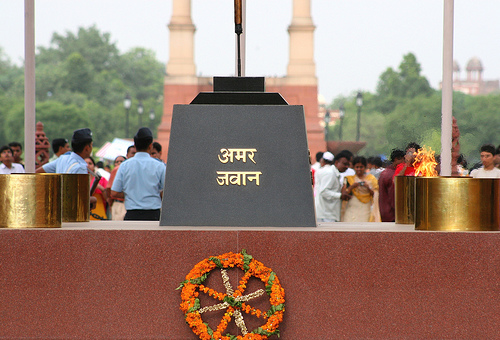
Originally, a Statue of King George V had stood under the now-vacant canopy in front of the India Gate, and was removed to Coronation Park with other statues. Following India's independence, India Gate became the site of the Indian Army's Tomb of the Unknown Soldier, known as the Amar Jawan Jyoti (The flame of the immortal soldier).
The 42-metre tall India Gate is situated such that many important roads spread out from it. Traffic passing around India Gate used to be continuous until the roads were closed to the public due to terrorist threats.
The lawns around Rajpath throng with people during the evening, when the India Gate is lit up. Ice cream and street food vendors come out during this time and it becomes a popular picnic venue for families.

The India Gate hexagon complex covers approximately 306000m² in area with a diameter of about 625m.

Amar Jawan Jyoti

Amar Jawan Jyoti
This cenotaph is itself placed on an edifice which has on its four corners four torches that are perpetually kept alive. It was unveiled in 1971. After the Indo-Pak war of 1971, The then Prime Minister of india Mrs. Indira Gandhi paid homage on behalf of the whole nation on the eve of 23rd republic day (26th january 1972).Burning in a shrine under the arch of India Gate since 1971 is the Amar Jawan Jyoti (the flame of the immortal soldier) which marks the Tomb of the Unknown Soldier. The shrine itself is a black marble cenotaph with a rifle placed on its barrel, crested by a soldier's helmet. Each face of the cenotaph has inscribed in gold the words "Amar Jawan" (Immortal Warrior).
Today, it is customary for the President and the Prime Minister, as well as visiting Guests of State, to pay homage at the site on occasions of State ceremonies.
And specially on each Republic Day, 26 January, the Prime Minister pays homage to the soldiers along with Heads of Armed Forces, before joining the annual parade at the Rajpath, It is noteworthy here that the President of India with the chief guest do not get involved in this ceremony on this day.
The flags represent the 3 Indian military forces (Army, Navy, and Air Force), and a soldier from each force guards the gate and tomb for 24 hours, alternating forces every day.


Agra Fort


Agra Fort (आगरा का लाल किला) is a UNESCO World Heritage site located in AgraIndia. It is about 2.5 km northwest of its more famous sister monument, the Taj Mahal. The fort can be more accurately described as a walled city.
After Panipat, Mughals captured the fort and a vast treasure - which included a diamond that was later named as the Koh-i-Noor diamond - was seized. Babur stayed in the fort in the palace of Ibrahim. He built a baoli (step well) in it. Humayun was crowned here in 1530.Humayun was defeated in Bilgram in 1540. Sher Shah held the fort for five years. The Mughals defeated the Afghans finally at Panipat in 1556.
Realizing the importance of its central situation, Akbar made it his capital and arrived in Agra in 1558. His historian, Abdul Fazal, recorded that this was a brick fort known as 'Badalgarh' . It was in a ruined condition and Akbar had it rebuilt with red sandstone from Barauli area in Rajasthan. Architects laid the foundation and it was built with bricks in the inner core with sandstone on external surfaces. Builders worked on it for eight years, completing it in 1573.

It was only during the reign of Akbar's grandson, Shah Jahan, that the site took on its current state. The legend is that Shah Jahan built the beautiful Taj Mahal for his wife, Mumtaz Mahal. Unlike his grandfather, Shah Jahan tended to have buildings made from white marble, often inlaid with gold or semi-precious gems. He destroyed some of the earlier buildings inside the fort in order to make his own.
At the end of his life, Shah Jahan was imprisoned by his son, Aurangzeb, in the fort. It is rumored that Shah Jahan died in Musamman Burj, a tower with a marble balcony with a view of the Taj Mahal.
The fort was the site of a battle during the Indian rebellion of 1857, which caused the end of the British East India Company's rule in India, and led to a century of direct rule of India by Britain.

Red Fort, Delhi


The Red Fort (लाल किला) is a 17th century fort complex constructed by the Mughal emperor Shah Jahan in the walled city of Old Delhi (in present day Delhi, India) that served as the residence of the Imperial Family of India. It also served as the capital of the Mughals until 1857, when Mughal emperor Bahadur Shah Zafar was exiled by the British Indian government. The British used it as a military camp until India became independent in 1947. It is now a popular tourist site, as well as a powerful symbol of India's sovereignty: the Prime Minister of India raises the flag of India on the ramparts of the Lahori Gate of the fort complex every year on Independence Day. It was designated a UNESCO World Heritage Site in 2007
Mughal Emperor Shahjahan, started construction of the massive fort in 1638 and work was completed in 1648 (10 years). The Red Fort was originally referred to as "Qila-i-Mubarak" (the blessed fort), because it was the residence of the royal family. The layout of the Red Fort was organised to retain and integrate this site with the Salimgarh Fort. The fortress palace was an important focal point of the medieval city of Shahjahanabad. The planning and aesthetics of the Red Fort represent the zenith of Mughal creativity which prevailed during the reign of Emperor Shah Jahan. This Fort has had many developments added on after its construction by Emperor Shahjahan. The significant phases of development were under Aurangzeb and later Mughal rulers. Important physical changes were carried out in the overall settings of the site after the Indian Mutiny in 1857. After Independence, the site experienced a few changes in terms of addition/alteration to the structures. During the British period the Fort was mainly used as a cantonment and even after Independence, a significant part of the Fort remained under the control of the Indian Army until the year 2003. The Red Fort is an attraction for tourists from around the world.
The Red Fort was the palace for Mughal Emperor Shah Jahan's new capital, Shahjahanabad, the seventh city in the Delhi site. He moved his capital here from Agra in a move designed to bring prestige to his reign, and to provide ample opportunity to apply his ambitious building schemes and interests.
The fort lies along the Yamuna River, which fed the moats that surround most of the wall. The wall at its north-eastern corner is adjacent to an older fort, the Salimgarh Fort, a defence built by Islam Shah Suri in 1546.The construction of the Red Fort began in 1638 and was completed by 1648.
The last Mughal emperor to occupy the fort was Bahadur Shah II "Zafar". Despite being the seat of Mughal power and its defensive capabilities, the Red Fort was not defended during the 1857 uprising against the British. After the failure of the 1857 rebellion, Zafar left the fort on 17 September. He returned to Red Fort as a prisoner of the British. Zafar was tried on in a trial starting on 27 January 1858, and was exiled on 7 October.On 11 March 1783, Sikhs briefly entered Red Fort in Delhi and occupied the Diwan-i-Am. The city was essentially surrendered by the Mughal wazir in cahoots with his Sikh Allies. This task was carried out under the command of Baba Jassa Singh Ahluwalia and Sardar Baghel Singh Dhaliwal, who led Karor Singhia misl which comprised Jat Sikhs from present day Amritsar and Tarn Taran districts (some major villages being Chabal, Naushehra Pannuan, Sirhali, Guruwali, Chabba, Sur Singh, Bhikhiwind, Khadur Sahib, Chola Sahib etc.) .

Battle of Alesia


Julius Ceaser

The Battle of Alesia or Siege of Alesia took place in September, 52 BC around the Gallic oppidum of Alesia, a major town centre and hill fort of the Mandubii tribe. It was fought by an army of the Roman Republic commanded by Julius Caesar, aided by cavalry commanders Mark Antony, Titus Labienus and Gaius Trebonius, against a confederation of Gallic tribes united under the leadership of Vercingetorix of the Averni, and was the last major engagement between Gauls and Romans, marking the turning point of the Gallic Wars in favour of Rome. The Siege of Alesia is considered one of Caesar's greatest military achievements, and is still one of the classic examples of siege warfare and investment. The battle of Alesia can safely be described as the official end of the Celtic heritage in France, Belgium, Switzerland and Northern Italy.
The battle site was probably atop Mont Auxois, above modern Alise-Sainte-Reine in France, but this location—some have argued—does not fit Caesar's description of the battle. A number of alternatives have been proposed over time, among which only Chaux-des-Crotenay (in Jura in modern France) remains a challenger today.
At one point in the battle the Romans were outnumbered by the Gauls by four to one. The event is described by several contemporary authors, including Caesar himself in his Commentarii de Bello Gallico. After the Roman victory, Gaul (very roughly modern France) was subdued and became a Roman province. The refusal of the Roman senate to allow Caesar the honour of a triumph for his victory in the Gallic Wars eventually led, in part, to the Roman Civil War of 49–45 BC.

Thursday, March 31, 2011

Swami Vivekananda

Swami Vivekananda (January 12, 1863–July 4, 1902), born Narendranath Dutta was the chief disciple of the 19th century mystic Sri Ramakrishna Paramahamsa and the founder of Ramakrishna Mission. He is considered a key figure in the introduction of Hindu philosophies of Vedanta and Yoga in Europe and America and is also credited with raising interfaith awareness, bringing Hinduism to the status of a major world religion during the end of the 19th century. Vivekananda is considered to be a major force in the revival of Hinduism in modern India. He is perhaps best known for his inspiring speech beginning with "Sisters and Brothers of America", through which he introduced Hinduism at the Parliament of the World's Religions at Chicago in 1893. Swami Vivekananda was born in an aristocratic Bengali family of Calcutta in 1863. Swami's parents influenced his thinking—the father by his rational mind and the mother by her religious temperament. From his childhood, he showed inclination towards spirituality and God realization. While searching for a man who could directly demonstrate the reality of God, he came to Ramakrishna and became his disciple. As a guru, Ramakrishna taught him Advaita Vedanta (non-dualism) and that all religions are true, and service to man was the most effective worship of God. After the death of his Guru, Vivekananda became a wandering monk, touring the Indian subcontinent and getting first-hand knowledge of India's condition. He later sailed to Chicago and represented India as a delegate in the 1893 Parliament of World Religions. An eloquent speaker, Vivekananda was invited to several forums in the United States and spoke at universities and clubs. He conducted hundreds of public and private lectures and classes, disseminating Vedanta and Yoga in America, England and a few other countries in Europe. He also established the Vedanta societies in America and England. Later he sailed back to India and in 1897 founded the Ramakrishna Math and Ramakrishna Mission, a philanthropic and spiritual organization.

Aurangzeb


Abul Muzaffar Muhy-ud-Din Muhammad Aurangzeb Alamgir (4 November 1618 [O.S. 25 October] – 3 March 1707 [O.S. 20 February]), more commonly known as Aurangzeb or by his chosen imperial title Alamgir, was the sixth Mughal Emperor of India, whose reign lasted from 1658 until his death in 1707.
Badshah Aurangzeb Alamgir I, having ruled most of the Indian subcontinent for nearly half a century, was the second longest reigning Mughal emperor after the legendary Akbar. In this period he tried hard to get a larger area, notably in southern India, under Mughal rule than ever before. But after his death in 1707, the Mughal Empire gradually began to shrink. Major reasons include a weak chain of "Later Mughals", an inadequate focus on maintaining central administration leading to governors forming their own empires, a gradual depletion of the fortunes amassed by his predecessors and the growth of secessionist sentiments amongst the other communities of the empire like the Marathas.

Early life

Aurangzeb was the third son of the fifth Mughal emperor Shah Jahan and Mumtaz Mahal (Arjumand Bānū Begum). After a rebellion by his father, part of Aurangzeb's childhood was spent as a virtual hostage at his grandfather Jahangir's court. Muhammad Saleh Kamboh had been one of his childhood teachers.
After Jahangir's death in 1627, Aurangzeb returned to live with his parents. Shah Jahan followed the Mughal practice of assigning authority to his sons, and in 1634 put Aurangzeb in charge of the Deccan campaign. Following his success in 1636, Aurangzeb became Subahdar(governor) of the Deccan. At this time, he began building a new city near the former capital of Khirki which he named Aurangabad after himself. In 1637, he married Rabia Durrani. During this period the Deccan was relatively peaceful. In the Mughal court, however, Shah Jahan began to show greater and greater favoritism to his eldest son Dara Shikoh.
In 1644, Aurangzeb's sister Jahanara Begum was accidentally burned in Agra. This event precipitated a family crisis which had political consequences. Aurangzeb suffered his father's displeasure when he returned to Agra three weeks after the event, instead of immediately. Shah Jahan dismissed him as the governor of the Deccan. Aurangzeb later claimed (1654) that he had resigned in protest of his father favoring Dara.
In 1645, he was barred from the court for seven months. But later, Shah Jahan appointed him governor of Gujarat; he performed well and was rewarded. In 1647, Shah Jahan made him governor of Balkh and Badakhshan (in modern Afghanistan and Tajikistan), replacing Aurangzeb's ineffective brother Murad Baksh. These areas at the time were under attack from various forces and Aurangzeb's military skill proved successful.
He was appointed governor of Multan and Sindh, and began a protracted military struggle against the Safavid army in an effort to capture the city of Kandahar. He failed, and fell again into his father's disfavour.
In 1652, Aurangzeb was re-appointed governor of the Deccan. In an effort to extend the empire, Aurangzeb attacked the border kingdoms of Golconda (1657), and Bijapur (1658). Both times, Shah Jahan called off the attacks near the moment of Aurangzeb's triumph. In each case Dara Shikoh interceded and arranged a peaceful end to the attacks.

War of succession

Soon after, Shuja's youngest brother Murad Baksh, with secret promises of support from Aurangzeb, declared himself emperor in Gujarat. Aurangzeb, ostensibly in support of Murad, marched north from Aurangabad, gathering support from nobles and generals. Following a series of victories, Aurangzeb declared that Dara had illegally usurped the throne. Shah Jahan, determined that Dara would succeed him, handed over control of his empire to Dara. A Rajput lord opposed to Aurangzeb and Murad, Maharaja Jaswant Singh, battled them both at Dharmatpur near Ujjain. Aurangzeb eventually defeated Singh and concentrated his forces on Dara. A series of bloody battles followed, with troops loyal to Aurangzeb battering Dara's armies at Samugarh. In a few months, Aurangzeb's forces surrounded Agra. Fearing for his life, Dara departed for Delhi, leaving Shah Jahan behind. The old emperor surrendered the Agra Fort to Aurangzeb's nobles, but Aurangzeb refused any meeting with his father, and declared that Dara was no longer a Muslim.Shah Jahan fell ill in 1657. With this news, the struggle for the succession began. Aurangzeb's eldest brother, Dara Shikoh, was regarded as heir apparent, but the succession proved far from certain when Shah Jahan's second son Shah Shuja declared himself emperor in Bengal. Imperial armies sent by Dara and Shah Jahan soon restrained this effort, and Shuja retreated.
In a sudden reversal, Aurangzeb arrested his brother Murad, whose former supporters defected to Aurangzeb in return for rich gifts. Meanwhile, Dara gathered his forces, and moved to the Punjab. The army sent against Shuja was trapped in the east, its generals Jai Singh and Diler Khan, submitted to Aurangzeb, but allowed Dara's son Suleman to escape. Aurangzeb offered Shuja the governorship of Bengal. This move had the effect of isolating Dara and causing more troops to defect to Aurangzeb. Shuja, however, uncertain of Aurangzeb's sincerity, continued to battle his brother, but his forces suffered a series of defeats at Aurangzeb's hands. Shuja fled to Arakan (in present-day Burma), where he was executed after leading a failed coup. Murad was finally executed, ostensibly for the murder of his former divan Ali Naqi, in 1661.
With Shuja and Murad disposed of, and with his father Shah Jahan confined in Agra, Aurangzeb pursued Dara, chasing him across the north-western bounds of the empire. After a series of battles, defeats and retreats, Dara was betrayed by one of his generals, who arrested and bound him. In 1659, Aurangzeb arranged his formal coronation in Delhi. He had Dara openly marched in chains back to Delhi; when Dara finally arrived, Aurangzeb had him executed on 30 August 1659. Having secured his position, Aurangzeb kept an already weakening Shah Jahan under house arrest at the Agra Fort. Shah Jahan died in 1666.

Expansion of the Mughal Empire

Nizams's of Ahmednagar, Adilshahi's of Bijapur mostly surrendered and their territories were administered by Mughal Nawab. Qutbshahi's of Golconda however refused to surrender they fortified themselves at Golconda Fort, and fiercely protected Kollur Mine (the worlds only diamond mine). After a long siege Mughal forces managed to penetrate the walls by capturing a gate. Qutbshahi's of Golconda and Abul Hasan Qutb Shah surrendered and handed over the Nur-Ul-Ain Diamond, The Hope Diamond, Wittelsbach Diamond and the The Regent Diamond making the Mughal Emperor the richest monarch in the world. From the start of his reign up until his death, Aurangzeb engaged in almost constant warfare. He built up a massive army, and began a program of military expansion along all the boundaries of his empire. Aurangzeb pushed north-west into the Punjab and what is now Afghanistan; he also drove south, conquering three Muslim kingdoms: Nizams's of Ahmednagar, Adilshahi's of Bijapur and Qutbshahi's of Golconda.
This combination of military expansion and religious intolerance had deeper consequences. Though he succeeded in expanding Mughal control, it was at an enormous cost in lives and treasure. And, as the empire expanded in size, Aurangzeb's chain of command grew weaker. The Sikhs of the Punjab grew both in strength and numbers, and launched rebellions. The Marathas waged a war with Aurangzeb which lasted for 27 years. Even Aurangzeb's own armies grew restive — particularly the fierce Rajputs, who were his main source of strength. Aurangzeb gave a wide berth to the Rajputs, who were mostly Hindu. While they fought for Aurangzeb during his life, on his death they immediately revolted against his successors.
With much of his attention on military matters, Aurangzeb's political power waned, and his incompetent provincial Nawabs grew in authority.

Rebellions

Aurangzeb's reign is marked by numerous rebellions in the distant provinces of the Mughal Empire, many historians believe that Mughal Nawabs were incapable of bridging the gap between the rulers and the people; therefore many new identities emerged along with it armed rebellion.
  • In 1669, the Jat peasants of Bharatpur around Mathura revolted and led to the formation of Bharatpur state, they formulated a fierce rebellion around the Mughal capitol.
  • In 1670, Shivaji, assissanited the Adil Shahi commander Afzal Khan and later his rebels almost killed the Mughal Viceroy Shaista Khan, and waged the war against the Mughal Emperor Aurangzeb. Shivaji and his forces ravaged the Deccan, Janjira and tried to gain control of vast territories. However by 1689 Auranzeb's armies had captured the successor of Shivaji, his son Sambhaji alive and executed. But even after Sambhaji's death, Aurangzeb could never completely eradicate the Maratha rebels ever in his 27 years of war against them.
  • In 1672, the Satnami, a sect concentrated in an area near Delhi, under the leadership of Bhirbhan and some Satnami, took over the administration of Narnaul, but they were eventually crushed upon Aurangzeb's personal intervention with very few escaping alive.
  • In 1699, on his orders the Mughal governor of Sarhind surrounded the fort of Anandpur in Punjab, which was occupied by Guru Gobind Singh and well armed Sikhs. After oaths of safety by the Mughal forces, Guru Gobind Singh decided to leave the fort. However the Mughal forces broke their promises and attacked the Guru and the Sikhs. The Mughals held his 2 young sons Sahibzada Zorawar Singh and Sahibzada Fateh Singh captive and executed through Immurement. Meanwhile his elder sons (15 and 17 years old) named Sahibzada Jujhar Singh and Sahibzada Ajit Singh fell fighting Mughal Musketeers at Chamkaur (close to Anandpur Fort). Gobind Singh wrote a letter named Zafarnamah to Aurungzeb. The letter is written in exquisite Persian verse. In this letter, Guru Gobind Singh Ji reminds Aurangzeb how he and his henchmen had broken their oaths taken by the holy Qu'ran and loyalty to the Mughal Empire.
  • In 1671, The Battle of Saraighat between the Mughal Empire , and the Ahom Kingdom. The battle was a disaster for the Mughal army. The Mughal army was utterly annihilated due to the bravery of the Ahom general and his Hindu army. This battle was a watershed point in Indian history since it seriously checked Mughal invasions notably under the cruelest among them all, Aurangzeb. During the battle the Mughal's were led by Mir Jumla II and Shaista Khan. During the course of the battle the Mughal Admiral, Munnawar Khan was killed.

The Deccan wars and the Rise of the Marathas

In 1657, while Aurangzeb attacked Golconda and Bijapur, Shivaji, using guerrilla tactics, took control of three Adilshahi forts formerly controlled by his father. With these victories, Shivaji assumed de facto leadership of many independent Maratha clans. The Marathas harried the flanks of the warring Adilshahi and Mughals, gaining weapons, forts, and territories. Shivaji's small and ill-equipped army survived an all out Adilshahi attack, and Shivaji personally killed the Adilshahi general, Afzal Khan. With this event, the Marathas transformed into a powerful military force, capturing more and more Adilshahi and Mughal territories. In the time of Shah Jahan, the Deccan had been controlled by three Muslim kingdoms: Ahmednagar (Nizams), Bijapur (Adilshahi) and Golconda (Qutbshahi). Following a series of battles, Ahmednagar was effectively divided, with large portions of the kingdom ceded to the Mughals and the balance to Bijapur. One of Ahmednagar's generals, a Hindu Maratha named Shahaji, joined the Bijapur court. Shahaji sent his wife Jijabai and young son Shivaji in Pune to look after his Jagir.
Just before Shivaji Raje's his coronation in 1659, Aurangzeb sent his trusted general and maternal uncle Shaista Khan the Mughal Viceroy to the Deccan to recover lost forts occupied by the Maratha rebels. Shaista Khan drove into Maratha territory and took up residence in Pune. In a daring raid, Shivaji attacked the governor's residence in Pune during a midnight wedding celebration. The Marathas killed Shaista Khan's son, even hacking off most of Shaista Khan's hand. Shaista Khan however barely survived and was re-appointed as the administrator of Bengal and was a key commander in the war against the Ahoms.
Aurangzeb ignored the rise of the Marathas for the next few years as he was occupied with other religious and political matters including the rise of Sikhism. Shivaji captured forts belonging to both Mughals and Bijapur. At last Aurangzeb sent his powerful general Raja Jai Singh of Amber, a Hindu Rajput, to attack the Marathas. Jai Singh won fort of Purandar after fierce battle in which the maratha commander Murarbaji fell. Foreseeing defeat, Shivaji agreed for a truce and meeting Aurangjeb at Delhi. Jai Singh also promised the Maratha hero his safety, placing him under the care of his own son, the future Raja Ram Singh I. However, circumstances at the Mughal court were beyond the control of the Raja, and when Shivaji and his son Sambhaji went to Agra to meet Aurangzeb, they were placed under house arrest, from which they managed to effect a daring escape.
Shivaji returned to the Deccan, and was crowned Chhatrapati or Emperor of the Maratha Empire in 1674. While Aurangzeb continued to send troops against him, Shivaji expanded Maratha control throughout the Deccan until his death in 1680. Shivaji was succeeded by his son Sambhaji. Militarily and politically, Mughal efforts to control the Deccan continued to fail. Aurangzeb's son Akbar left the Mughal court and joined Muslim rebels in Deccan. Aurangzeb in response moved his court to Aurangabad and took over command of the Deccan campaign. More battles ensued, and Akbar fled to Persia and never returned.
In 1689 Aurangzeb's forces captured Sambhaji, his successor chhatrapati Rajaram and his, Maratha forces fought individual battles against the forces of the Mughal Empire, and territory changed hands again and again during years of endless warfare. As there was no central authority among the Marathas, Aurangzeb was forced to contest every inch of territory, at great cost in lives and treasure against an organized force. Even as Aurangzeb drove west, deep into Maratha territory — notably conquering Satara — the Marathas expanded their attacks further into Mughal lands, including Mughal provinces of Malwa, Hyderabad, Jinji in TamilNadu. Aurangzeb waged continuous war in the Deccan for more than two decades with no resolution. Aurangzeb lost about a fifth of his army fighting rebellions led by the Marathas in Deccan India. He came down thousands of miles to the Deccan to conquer the Maratha confederacy and eventually died at the age of 90, during his final campaign against the Maratha confederacy.

Chatrapati

When Maharaja Jaswant Singh of Jodhpur died in 1679, a conflict ensued over who would be the next Raja. Aurangzeb's choice of a nephew of the former Maharaja was not accepted by other members of Jaswant Singh's family and they rebelled, but in vain. Aurangzeb seized control of Jodhpur. He also moved on Udaipur, which was the only other state of Rajputana to support the rebellion. There was never a clear resolution to this conflict, although it is noted that the other Rajputs, including the celebrated Kachhwaha Rajput clan of Raja Jai Singh, the Bhattis, and the Rathores, remained loyal. On the other hand, Aurangzeb's own third son, Prince Akbar, along with a few Muslim Mansabdar supporters, joined the rebels in the hope of dethroning his father and becoming emperor. The rebels were defeated and Akbar fled south to the shelter of the Maratha Chhatrapati Sambhaji, Chhatrapati Shivaji's successor.
The Ahoms (the people of Shan community of Thailand) were the kings who had established their kingdom in the basin of river Bramhaputra and made it impossible for the Mughals to conquer that area.

The Pashtun rebellion

The Pashtun tribesmen of the Empire were considered the bedrock of the Mughal Army. They were crucial defenders of the Empire from the threat of invasion from the North-West as well as the main fighting force against the Sikh and Maratha forces. The Pashtun revolt in 1672 under the leadership of the warrior poet Khushal Khan Khattak was triggered when soldiers under the orders of the Mughal Governor Amir Khan allegedly attempted to molest women of the Safi tribe in modern day Kunar. The Safi tribes attacked the soldiers. This attack provoked a reprisal, which triggered a general revolt of most of tribes. Attempting to reassert his authority, Amir Khan led a large Mughal Army to the Khyber Pass. There the army was surrounded by tribesmen and routed, with only four men, including the Governor, managing to escape.
After that the revolt spread, with the Mughals suffering a near total collapse of their authority along the Pashtun belt. The closure of the important Attock-Kabul trade route along the Grand Trunk road was particularly critical. By 1674, the situation had deteriorated to a point where Aurangzeb himself camped at Attock to personally take charge. Switching to diplomacy and bribery along with force of arms, the Mughals eventually split the rebellion and while they never managed to wield effective authority outside the main trade route, the revolt was partially suppressed. However the long term anarchy on the Empire's North-Western frontier that prevailed as a consequence ensured that the Persian Nadir Shah's forces half a century later faced little resistance on the road to Delhi, being one of the causes for Mughal decline and eventual European dominance.
LEGACY
Aurangzeb's vast imperial campaigns against rebellion-affected areas of the Mughal Empire, caused his opponents to exaggerate the "importance" of their rebellions. The results of his vast campaigns were made worse by the incompetence of his regional Nawabs. His critics decry this as intolerance,.
Muslim views regarding Aurangzeb vary, most Muslim historians believe that the Mughal Emperor Aurangzeb was the last powerful ruler of an empire inevitably on the verge of decline. The major rebellions organized by the Sikhs and the Marathas were long embedded and had deep roots in the remote regions of the Mughal Empire.
Unlike his predecessors, Aurangzeb considered the royal treasury as a trust of the citizens of his empire. He made caps and copied Quran to earn money for his use. He did not use royal treasury for personal expenses or extravagant building projects except, perhaps, for one project: he built the famous Badshahi Mosque in Lahore, which, for 313 years remained the world's largest mosque and still remains to this day the 5th largest mosque in the world. He also added a small marble mosque known as the Moti Masjid (Pearl Mosque) to the Red Fort complex in Delhi. His constant warfare especially with Marathas, however, drove his empire to the brink of bankruptcy just as much as the wasteful personal spending and opulence of his predecessors.
He died in Ahmednagar on Friday, 20 February 1707 at the age of 88, having outlived many of his children. His modest open-air grave in Khuldabad expresses his deep devotion to his Islamic beliefs. The tomb lies within the courtyard of the shrine of the Sufi saint Shaikh Burham-u'd-din Gharib (died 1331), who was a disciple of Nizamuddin Auliya of Delhi.
After Aurangzeb's death, his son Bahadur Shah I took the throne. The Mughal Empire, due both to Aurangzeb's over-extension and to Bahadur Shah's weak military and leadership qualities, entered a period of long decline. Immediately after Bahadur Shah occupied the throne, the Maratha Empire — which Aurangzeb had held at bay, inflicting high human and monetary costs — consolidated and launched effective invasions of Mughal territory, seizing power from the weak emperor. Within 100 years of Aurangzeb's death, the Mughal Emperor had little power beyond Delhi.


Tuesday, March 29, 2011

Lothal


Lothal is one of the most prominent cities of the ancient Indus valley civilization. Located in Bhāl region of the modern state of Gujarāt and dating from 2400 BCE. Discovered in 1954, Lothal was excavated from February 13, 1955 to May 19, 1960 by the Archaeological Survey of India (ASI).
Lothal's dock—the world's earliest known, connected the city to an ancient course of the Sabarmati river on the trade route between Harappan cities in Sindh and the peninsula of Saurashtra when the surrounding Kutch desert of today was a part of the Arabian Sea. It was a vital and thriving trade center in ancient times, with its trade of beads, gems and valuable ornaments reaching the far corners of West Asia and Africa. The techniques and tools they pioneered for bead-making and in metallurgy have stood the test of time for over 4000 years.
Lothal is situated near the village of Saragwala in the Dholka taluka of Ahmedabad district. It is six kilometers (south-east) of the Lothal-Bhurkhi railway station on the Ahmedabad-Bhavnagar railway line. It is also connected by all-weather roads to the cities of Ahmedabad (85 km/53 mi), Bhavnagar, Rajkot and Dholka. The nearest cities are Dholka and Bagodara. Resuming excavation in 1961, archaeologists unearthed trenches sunk on the northern, eastern and western flanks of the mound, bringing to light the inlet channels and nullah ("ravine", or "gully") connecting the dock with the river. The findings consist of a mound, a township, a marketplace, and the dock. Adjacent to the excavated areas stands the Archaeological Museum, where some of the most prominent collections of Indus-era antiquities in India are displayed.

Mohenjodaro

Mohenjo-daro situated in the province of Sindh, Pakistan, was one of the largest city-settlements of the Indus Valley Civilization. Built around 2600 BCE, it was one of the early urban settlements in the world, existing at the same time as the civilizations of ancient Egypt, Mesopotamia, and Crete. The archaeological ruins of the city are designated a UNESCO World Heritage Site. It is sometimes referred to as "an ancient Indus valley metropolis".

Rediscovery and excavation

Mohenjo-daro was built around 2600 BCE and abandoned around 1500 BCE. It was rediscovered in 1922 by Rakhaldas Bandyopadhyay, an officer of the Archaeological Survey of India. He was led to the mound by a Buddhist monk, who believed it to be a stupa. In the 1930s, massive excavations were conducted under the leadership of John Marshall, K. N. Dikshit, Ernest Mackay, and others. John Marshall's car, which was used by the site directors, is still in the Mohenjo-daro museum, showing their struggle and dedication to Mohenjo-daro. Further excavations were carried out in 1945 by Ahmad Hasan Dani and Mortimer Wheeler.
The last major excavations were conducted in 1964-65 by Dr. George F. Dales. After this date, excavations were banned due to damage done to the exposed structures by weathering. Since 1965, the only projects allowed at the site have been salvage excavation, surface surveys and conservation projects. Despite the ban on major archaeological projects, in the 1980s, teams of German and Italian survey groups, led by Dr. Michael Jansen and Dr. Maurizio Tosi, combined techniques such as architectural documentation, surface surveys, surface scraping and probing, to determine further clues about the ancient civilization.

Location

Mohenjo-daro is located in Sindh, Pakistan on a Pleistocene ridge in the middle of the flood plain of the Indus River Valley. The ridge is now buried by the flooding of the plains, but was prominent during the time of the Indus Valley Civilization. The ridge allowed the city to stand above the surrounding plain. The site occupies a central position between the Indus River valley on the west and the Ghaggar-Hakra river on the east. The Indus still flows to the east of the site, but the Ghaggar-Hakra riverbed is now dry.
Anthropogenic construction over the years was precipitated by the need for more room. The ridge was expanded via giant mud brick platforms. Ultimately, the settlement grew to such proportions that some buildings reached 12 meters above the level of the modern plain, and therefore much higher than this above the ancient plain.

Historical significance

Mohenjo-daro in ancient times was most likely one of the largest cities of the ancient Indus Valley Civilization.  It was the most developed and advanced city in South Asia, during its peak. The planning and engineering showed the importance of the city to the people of the Indus valley.
The Indus Valley Civilization (c. 3300–1700 BCE, flowered 2600–1900 BCE), abbreviated IVC, was an ancient riverine civilization that flourished in the Indus river valley (now Pakistan and northwest India). Another name for this civilization is the "Harappan Civilization" (Harappa is another important IVC site to the north of Mohenjo-daro in Punjab).
The Indus culture blossomed over the centuries and gave rise to the Indus Valley Civilization around 3000 BCE. The civilization spanned much of what is now Pakistan and North India, but suddenly went into decline around 1900 BCE. Indus Civilization settlements spread as far west as the Iranian border, with an outpost in Bactria, as far south as the Arabian Sea coast of western India in Gujarat. Among the settlements were the major urban centers of Harappa and Mohenjo-daro, as well as Lothal.

Architecture and urban infrastructure

The city had a central marketplace, with a large central well. Individual households or groups of households obtained their water from smaller wells. Waste water was channeled to covered drains that lined the major streets. Some houses, presumably those of wealthier inhabitants, include rooms that appear to have been set aside for bathing, and one building had an underground furnace (hypocaust), possibly for heated bathing. Most house have inner courtyards, with doors that opened onto side-lanes. Some buildings were two-storeyed.Mohenjo-daro has a planned layout based on a street-grid of rectilinear buildings. Most are of fired and mortared brick; some incorporate sun dried mud-brick and wooden superstructures. The sheer size of the city, and its provision of public buildings and facilities, suggests high levels of social organisation. At its peak of development, Mohenjo-Daro could have housed around 35,000 residents.
In 1950, Sir Mortimer Wheeler designated one large, probably public facility as a "Great Granary". Certain wall-divisions in its massive wooden superstructure appeared to be grain storage-bays, complete with air-ducts to dry the grain. According to Wheeler, carts would have brought grain from the countryside and unloaded them directly into the bays. However, Jonathan Mark Kenoyer note the complete lack of evidence for grain at "granary", which might therefore be better termed a "Great Hall" of uncertain function.
Close to the "Great Granary" is a large and elaborate public bath, sometimes called the Great Bath. From a colonnaded courtyard, steps lead down to the brick-built pool, which was waterproofed by a lining of bitumen. The pool is large – 12m long, 7m wide and 2.4m deep. It may have been used for religious purification. Other large buildings include a "Pillared Hall", thought to be an assembly hall of some kind. Near the Great Bath is the so-called "College Hall", a complex of buildings comprising 78 rooms and thought to have been a priestly residence.
Mohenjo-daro had no circuit of city walls but was otherwise well fortified, with towers to the west of the main settlement, and defensive fortifications to the south. Considering these fortifications and the structure of other major Indus valley cities like Harappa, lead to the question of whether Mohenjo-daro was an administrative center. Both Harappa and Mohenjo-daro share relatively the same architectural layout, and were generally not heavily fortified like other Indus Valley sites. It is obvious from the identical city layouts of all Indus sites, that there was some kind of political or administrative centrality, however the extent and functioning of an administrative center remains unclear.
Mohenjo-daro was successively destroyed and rebuilt at least seven times. Each time, the new cities were built directly on top of the old ones. Flooding by the Indus is thought to have been the cause of destruction.
The city is divided into two parts, the so-called Citadel and the Lower City. Most of the Lower City is yet to be uncovered, but the Citadel is known to have the public bath, a large residential structure designed to house 5,000 citizens and two large assembly halls.
Mohenjo-daro, Harappa and their civilization vanished from history until rediscovered in the 1920s. It was extensively excavated in the 1920s, but no in-depth excavations have been carried out since the 1960s.

Artifacts

A bronze "Dancing girl" statuette, 10.8 cm high and some 4,500 years old, was found in Mohenjo-daro in 1926. In 1973, British archaeologist Mortimer Wheeler described her as his favorite statuette:
"There is her little Balochi-style face with pouting lips and insolent look in the eyes. She's about fifteen years old I should think, not more, but she stands there with bangles all the way up her arm and nothing else on. A girl perfectly, for the moment, perfectly confident of herself and the world. There's nothing like her, I think, in the world."
John Marshall, one of the excavators at Mohenjo-daro, described her as a young ... girl, her hand on her hip in a half-impudent posture, and legs slightly forward as she beats time to the music with her legs and feet.
The archaeologist Gregory Possehl says, "We may not be certain that she was a dancer, but she was good at what she did and she knew it". The statue could well be of some queen or other important woman of the Indus Valley Civilization judging from the authority the figure commands.
In 1927 a seated male figure, 17.5 cm tall, was found in a building with unusually ornamental brickwork and a wall-niche. Though there is no evidence that priests or monarchs ruled the city, archeologists dubbed this dignified figure a "Priest King"; like the Dancing Girl, it has become symbolic of the Indus valley civilization.
This bearded sculpture wears a fillet around the head, an armband, and a cloak decorated with trefoil patterns that were originally filled with red pigment.
The two ends of the fillet fall along the back and though the hair is carefully combed towards the back of the head, no bun is present. The flat back of the head may have held a separately carved bun as is traditional on the other seated figures, or it could have held a more elaborate horn and plumed headdress.
Two holes beneath the highly stylized ears suggest that a necklace or other head ornament was attached to the sculpture. The left shoulder is covered with a cloak decorated with trefoil, double circle and single circle designs that were originally filled with red pigment. Drill holes in the center of each circle indicate they were made with a specialized drill and then touched up with a chisel. Eyes are deeply incised and may have held inlay. The upper lip is shaved and a short combed beard frames the face. The large crack in the face is the result of weathering or it may be due to original firing of this object.

Current UNESCO status

Preservation work for Mohenjo-daro was suspended in December 1996 after funding from the government and international organizations stopped. Site conservation work resumed in April 1997, utilizing monies provided by the U. N. Educational, Scientific, and Culture Organization (UNESCO). The funding provides $10 million over two decades to protect the standing structures and the site from flooding.


Monday, March 28, 2011

Harappa / Hadappa


Harappa is an archaeological site in Punjab, northeast Pakistan, about 35 km west of Sahiwal. The site takes its name from a modern village located near the former course of the Ravi River. The current village of Harappa is 6 km from the ancient site. Although modern Harappa has a train station left from the British times, it is just a small (pop. 15,000), Pakistani crossroads town.
The site of the ancient city contains the ruins of a Bronze Age fortified city, which was part of the Cemetery H culture and the Indus Valley Civilization, centered in Sindh and the Punjab. The city is believed to have had as many as 23,500 residents—considered large for its time.
The ancient city of Harappa was greatly destroyed under the British Raj, when bricks from the ruins were used as track ballast in the making of the Lahore-Multan Railroad.
In 2005 a controversial amusement park scheme at the site was abandoned when builders unearthed many archaeological artifacts during the early stages of construction work. A plea from the prominent Pakistani archaeologist Ahmed Hasan Dani to the Ministry of Culture resulted in a restoration of the site.
HISTORY
The Indus Valley Civilization (also known as Harappan culture) has its earliest roots in cultures such as that of Mehrgarh, approximately 6000 BCE. The two greatest cities, Mohenjo-daro and Harappa, emerged circa 2600 BCE along the Indus River valley in Punjab and Sindh. The civilization, with a writing system, urban centers, and diversified social and economic system, was rediscovered in the 1920s after excavations at Mohenjo-daro (which means "mound of the dead") in Sindh near Sukkur, and Harappa, in west Punjab south of Lahore. A number of other sites stretching from the Himalayan foothills in east Punjab, India in the north, to Gujarat in the south and east, and to Balochistan in the west have also been discovered and studied. Although the archaeological site at Harappa was partially damaged in 1857 when engineers constructing the Lahore-Multan railroad (as part of the Sind and Punjab Railway), used brick from the Harappa ruins for track ballast, an abundance of artifacts has nevertheless been found.
CULTURE AND ECONOMY
Indus Valley civilization was mainly an urban culture sustained by surplus agricultural production and commerce, the latter including trade with Sumer in southern Mesopotamia. Both Mohenjo-daro and Harappa are generally characterized as having "differentiated living quarters, flat-roofed brick houses, and fortified administrative or religious centers." Although such similarities have given rise to arguments for the existence of a standardized system of urban layout and planning, such similarities are largely due to the presence of a semi-orthogonal type of civic layout, and a comparison of the layouts of Mohenjo-daro and Harappa shows that they are in fact, arranged in a quite dissimilar fashion. The chert weights and measures of the Indus Valley Civilization, on the other hand, were highly standardized, and conform to a set scale of gradations. Distinctive seals were used, among other applications, perhaps for identification of property and shipment of goods. Although copper and bronze were in use, iron was not yet employed. "Cotton was woven and dyed for clothing; wheat, rice, and a variety of vegetables and fruits were cultivated; and a number of animals, including the humped bull, were domesticated." Wheel-made pottery—some of it adorned with animal and geometric motifs—has been found in profusion at all the major Indus sites. A centralized administration for each city, though not the whole civilization, has been inferred from the revealed cultural uniformity; however, it remains uncertain whether authority lay with a commercial oligarchy. There appears to be a complete lack of priestly "pomp or lavish display" that was common in other civilizations.
NOTES
  • The earliest radiocarbon dating mentioned on the web is 2725+-185 BCE (uncalibrated) or 3338, 3213, 3203 BCE calibrated, giving a midpoint of 3251 BCE. Kenoyer, Jonathan Mark (1991) Urban process in the Indus Tradition: A preliminary report. In Harappa Excavations, 1986-1990: A multidisciplanary approach to Second Millennium urbanism, edited by Richard H. Meadow: 29-59. Monographs in World Archaeology No.3. Prehistory Press, Madison Wisconsin.
  • Periods 4 and 5 are not dated at Harappa. The termination of the Harappan tradition at Harappa falls between 1900 and 1500 BCE.
  • Mohenjo-daro is another major city of the same period, located in Sindh province of Pakistan. One of its most well-known structures is the Great Bath of Mohenjo Daro.
  • Dholavira is an ancient Metropolitan City. The Harappans used roughly the same size bricks and weights as were used in other Indus cities, such as Mohenjo Daro and Dholavira. These cities were well planned with wide streets, public and private wells, drains, bathing platforms and reservoirs.

Chanakya

Chanakya (c. 350–283 BCE) was an adviser to the first Maurya Emperor Chandragupta (c. 340–293 BCE), and was the chief architect of his rise to power.Kautilya and Vishnugupta, the names by which the ancient South Asian political treatise called the Arthaśāstra identifies its author, are traditionally identified with Chanakya. It is important to identify Chanakya as Indian because his cultural significance has reached far and wide, and his words are just as internalised in other parts of South Asia. Chanakya has been considered as the pioneer of the field of economics and political science. In the Western world, he has been referred to as The Indian Machiavelli, although Chanakya's works predate Machiavelli's by about 1,800 years. Chanakya was a teacher in Takṣaśila, an ancient centre of learning, and was responsible for the creation of Mauryan empire, the first of its kind on the Indian subcontinent. His works were lost near the end of the Gupta dynasty and not rediscovered until 1915.

Identity

He is generally called Chanakya (derived from his father's name "Chanak") but, in his capacity as author of the Arthaśhāstra, is generally referred to as Kautilya derived from his gotra's name "Kotil" (Kautilya means "of Kotil"). He was a master of the shrewd act of diplomacy. He believed in four ways—Sama, Daana, Danda, Bheda (treating with Equality, Enticement, Punishment or War and Sowing Dissension.) The Arthaśhāstra identifies its author by the name Kautilya, except for one verse which refers to him by the name Vishnugupta. One of the earliest Sanskrit literatures to explicitly identify Chanakya with Vishnugupta was Vishnu Sharma's Panchatantra in the 3rd century BC.
K.C. Ojha puts forward the view that the traditional identification of Vishnugupta with Kautilya was caused by a confusion of editor and originator and suggests that Vishnugupta was a redactor of the original work of Kautilya. Thomas Burrow goes even further and suggests that Chanakya and Kautilya may have been two different people.
Kautilya's role in the formation of the Mauryan Empire is the essence of a historical/spiritual novel The Courtesan and the Sadhu by Dr. Mysore N. Prakash.
Two books are attributed to Chanakya: Arthashastra and Neetishastra which is also known as Chanakya Niti. The Arthashastra discusses monetary and fiscal policies, welfare,international relations, and war strategies in detail. Neetishastra is a treatise on the ideal way of life, and shows Chanakya's in-depth study of the Indian way of life. Chanakya also developed Neeti-Sutras (aphorisms - pithy sentences) that tell people how they should behave. Of these well-known 455 sutras, about 216 refer to raaja-neeti (the do's and don'ts of running a kingdom). Apparently, Chanakya used these sutras to groom Chandragupt and other selected disciples in the art of ruling a kingdom.

Legend

Chanakya was born with a complete set of teeth, a sign that he would become king, which is inappropriate for a Brahmin like Chanakya. Chāṇakya's teeth were therefore broken and it was prophesied that he will rule through another.Thomas R. Trautmann lists the following elements as common to different forms of the Chanakya legend:
  • The Nanda King throws Chānakya out of his court, prompting Chānakya to swear revenge.
  • Chānakya searches for one worthy for him to rule through. Chānakya encounters a young Chandragupta Maurya who is a born leader even as a child.
  • Chānakya's initial attempt to overthrow Nanda fails, whereupon he comes across a mother scolding her child for burning himself by eating from the middle of a bun or bowl of porridge rather than the cooler edge. Chāṇakya realizes his initial strategic error and, instead of attacking the heart of Nanda territory, slowly chips away at its edges.
  • Chānakya changed his alliance with the mountain king Parvata due to his obstinacy and non-adherence to the principles of the treaty as agreed.
  • Chānakya enlists the services of a fanatical weaver to rid the kingdom of rebels.
  • Chānakya adds poison to the food eaten by Chandragupt Maurya, now king, in order to make him immune. Unaware, Chandragupta feeds some of his food to his queen, who is in her ninth month of pregnancy. In order to save the heir to the throne, Chānakya cuts the queen open and extracts the foetus, who is named Bindusara because he was touched by a drop (bindu) of blood having poison.
  • Chānakya's political rivalry with Subandhu leads to his death.
Chanakya was a shrewd observer of nature. Once, it is said that Mauryan forces had to hide in a cave. There was no food, and the soldiers were starving.They could not come out of the cave either, as there was a threat to their lives. Chanakya saw an ant taking a grain of rice, whereas, there was no sign of food or grain anywhere. Moreover, the rice grain was cooked. He ordered the soldiers to search and they found that their enemies had been dining under the cave. Indeed, they were eating at the ground floor. As soon as they saw this, they escaped and were thus saved.
Birth and Origin: Chanakya (c.350 - c.275 BC), also known as Anshul or Anshu or Kautilya or Vishnugupta was born in a family of Brahmin as the son of Acharya Chanak in Pataliputra, Magadh (Modern day Patna, Bihar, India. In the modern day it has been found that social, political and professional life of Brahmins reflects Chanakya Neeti. A South Indian group of Brahmins, Chozhiyas, claim that Chanakya was one of them. Though this may sound very improbable considering the vast distance between present day Tamil Nadu in the south and Magadha in Bihar, it finds curious echos in Parishista-parvan, where Hemachandra claims that Chankya was a Dramila (Dramila, being a very common variant of Dravida). Chanakya enjoyed the best education of the time, in 'Takshashila' (also known in its corrupted form as Taxila).Takshasilâ had established itself as a place of learning. The school had by that time existed for at least five centuries and attracted students from all over the ancient world of Southeast Asia. The Kingdom of Magadha maintained contact with Takshasilâ. Chanakya's life was connected to these two cities, Pataliputra and Takshasilâ. According to Jaina accounts[1] Chānakya was born in the village of Caṇaka in the Golla district to Caṇin and Caṇeśvarī, a Maga Brahmin couple[2].

Death

According to the Jain texts, Chanakya lived to a ripe old age and died around 275 BC and was cremated by his disciple Radhagupta who succeeded Rakshasa Katyayan (great-grand son of Prabuddha Katyayan, who attained Nirvana during the same period as Gautam Budhha) as Prime Minister of the Maurya Empire and was instrumental in backing Ashoka to the throne.
According to a Jaina tradition, while Chanakya served as the chief administrator of Chandragupta Maurya, he started adding small amounts of poison in Chandragupta's food so that he would get used to it. The aim of this was to prevent the Emperor from being poisoned by enemies. One day the queen, Durdha, shared the food with the Emperor while she was pregnant. Since she was not used to eating poisoned food, she died. Chanakya decided that the baby should not die; hence he cut open the belly of the queen and took out the baby. A drop (bindu in Sanskrit) of poison had passed to the baby's head, and hence Chanakya named him Bindusara. Bindusara would go on to become a great king and to father the greatest Mauryan Emperor since Chandragupt - Asoka.
When Bindusara became a youth, Chandragupta gave up the throne and followed the Jain saint Bhadrabahu to present day Karnataka and settled in a place known as Shravana Belagola. He lived as an ascetic for some years and died of voluntary starvation according to Jain tradition.
Chanakya meanwhile stayed as the administrator of Bindusara. Bindusara also had a minister named Subandhu who did not like Chanakya. One day he told Bindusara that Chanakya was responsible for the murder of his mother. Bindusara asked the nurses who confirmed this story and he became very angry with Chanakya.
It is said that Chanakya, on hearing that the Emperor was angry with him, thought that anyway he was at the end of his life. He donated all his wealth to the poor, widows and orphans and sat on a dung heap, prepared to die by total abstinence from food and drink. Bindusara meanwhile heard the full story of his birth from the nurses and rushed to beg forgiveness of Chanakya. But Chanakya would not change his mind. Bindusara went back and vented his fury on Subandhu, and killed him.
Chanakya after this incident, renounced food and shortly died thereafter. Bindusara revered Chanakya and the loss of his advisor was a considerable blow to him.

Other versions

The classical Sanskrit play by Vishakhadatta, Mudrarakshasa, is one popular source of Chanakya lore. (The play has been dated between 4th and 9th century CE).
According one tradition, Chanakya was a native of Dravida. One of Chanakya's various names was Dramila, the Sanskrit form of "Tamilian". ("Dramila" is believed to be the root of the word "Dravida" by some scholars). Chozhiars, a sub-sect of Iyers, hold that Chanakya was one of them.
There is also a claim that Chanakya belonged to the Brahmin group from the present day Kerala and believed to be resident of present day Ernakulam. In true Hindu tradition he is said to have persuaded King Chandragupta Maurya to forsake his throne and to join him in moving to the last phase of one's life viz. Vanaprastha. Accordingly, he took the King along with him to South India where both of them carried prolonged meditation and finally achieved Moksha.
Kautilya was educated at Taxila or Takshashila. The new states (in present-day Bihar and Uttar Pradesh) by the northern high road of commerce along the base of the Himalayas maintained contact with Takshasilâ and at the eastern end of the northern high road (uttarapatha) was the kingdom of Magadha with its capital city, Pataliputra, now known as Patna. Chanakya's life was connected to these two cities, Pataliputra and Taxila.
In his early years he was tutored extensively in the Vedas - Chanakya memorized them completely at a very early age. He was also taught mathematics, geography and science along with religion. Later he travelled to Takshashila, where he became a teacher of politics. Chanakya taught subjects using the best of practical knowledge acquired by the teachers. The age of entering the University was sixteen. The branches of study most sought after around India at that time ranged from law, medicine, warfare and other disciplines. Two of his more famous students were Bhadrabhatta and Purushdutta.
Political turmoil in Western India at that time caused by Greek invasion forced Chanakya to leave the University environment for the city of Pataliputra (presently known as Patna, in the state of Bihar, India), which was ruled by the Nanda king Dhanananda. Although Chanakya initially prospered in his relations with the ruler, being a blunt person he was soon disliked by Dhanananda. This ended with Chanakya being removed from an official position he enjoyed.
According to the Kashmiri version of his legend, ChāṇakyaThere is an anecdote which says a thorn had pricked his foot once. After that instead of uprooting the tree, he poured buttermilk on the tree so that the ants will gather around tree and finish the tree to its last pieces.