Showing posts with label General Studies. Show all posts

Thursday, April 7, 2011

Homi Jehangir Bhabha

Homi Jehangir Bhabha, FRS (30 October 1909 – 24 January 1966) was an Indian nuclear physicist and the chief architect of the Indian atomic energy program. He was also responsible for the establishment of two well-known research institutions, namely the Tata Institute of Fundamental Research (TIFR), and the Atomic Energy Establishment at Trombay (which after Bhabha's death was renamed as the Bhabha Atomic Research Centre (BARC)). As a scientist, he is remembered for deriving a correct expression for the probability of scattering positrons by electrons, a process now known as Bhabha scattering.

Early life

Bhabha was born into a wealthy and prominent Parsi family, through which he was related to Dinshaw Maneckji Petit, Muhammad Ali Jinnah and Dorab Tata. He received his early education at Bombay's Cathedral Grammar School and entered Elphinstone College at age 15 after passing his Senior Cambridge Examination with Honors. He then attended the Royal Institute of Science until 1927 before joining Caius College of Cambridge University. This was due to the insistence of his father and his uncle Dorab Tata, who planned for Bhabha to obtain an engineering degree from Cambridge and then return to India, where he would join the Tata Iron and Steel Company in Jamshedpur.

Higher education and research at Cambridge

At Cambridge Bhabha's interests gradually shifted to theoretical physics. In 1928 Bhabha in a letter to his father wrote:
“I seriously say to you that business or job as an engineer is not the thing for me. It is totally foreign to my nature and radically opposed to my temperament and opinions. Physics is my line. I know I shall do great things here. For, each man can do best and excel in only that thing of which he is passionately fond, in which he believes, as I do, that he has the ability to do it, that he is in fact born and destined to do it... I am burning with a desire to do physics. I will and must do it sometime. It is my only ambition. I have no desire to be a `successful' man or the head of a big firm. There are intelligent people who like that and let them do it... It is no use saying to Beethoven `You must be a scientist for it is great thing ' when he did not care two hoots for science; or to Socrates `Be an engineer; it is work of intelligent man'. It is not in the nature of things. I therefore earnestly implore you to let me do physics.”
Bhabha's father understood his son's predicament, and he agreed to finance his studies in mathematics provided that he obtain first class on his Mechanical Sciences Tripos. Bhabha took the Tripos in June 1930 and passed with first class. He then embarked on his mathematical studies under Paul Dirac to complete the Mathematics Tripos. Meanwhile, he worked at the Cavendish Laboratory while working towards his doctorate in theoretical physics under R. H. Fowler. At the time, the laboratory was the center of a number of scientific breakthroughs. James Chadwick had discovered the neutron, John Cockcroft and Ernest Walton transmuted lithium with high-energy protons, and Patrick Blackett and Giuseppe Occhialini used cloud chambers to demonstrate the production of electron pairs and showers by gamma radiation. During the 1931–1932 academic year, Bhabha was awarded the Salomons Studentship in Engineering. In 1932, he obtained first class on his Mathematical Tripos and was awarded the Rouse Ball traveling studentship in mathematics. With the studentship, he worked with Wolfgang Pauli in Zürich, Enrico Fermi in Rome and Hans Kramers in Utrecht.

Research in theoretical physics

In January 1933, Bhabha published his first scientific paper, "The Absorption of Cosmic radition. In the publication, Bhabha offered an explanation of the absorption features and electron shower production in cosmic rays.The paper helped him win the Isaac Newton Studentship in 1934, which he held for the next three years. The following year, he completed his doctoral studies in theoretical physics under Ralph H. Fowler. During his studentship, he split his time working at Cambridge and with Niels Bohr in Copenhagen. In 1935, Bhabha published a paper in the Proceedings of the Royal Society, Series A, in which performed the first calculation to determine the cross section of electron-positron scattering. Electron-positron scattering was later named Bhabha scattering, in honor of his contributions in the field.
In 1936, the two published a paper, "The Passage of Fast Electrons and the Theory of Cosmic Showers" in the Proceedings of the Royal Society, Series A, in which they used their theory to describe how primary cosmic rays from outer space interact with the upper atmosphere to produce particles observed at the ground level. Bhabha and Heitler then made numerical estimates of the number of electrons in the cascade process at different altitudes for different electron initiation energies. The calculations agreed with the experimental observations of cosmic ray showers made by Bruno Rossi and Pierre Victor Auger a few years before. Bhabha later concluded that observations of the properties of such particles would lead to the straightforward experimental verification of Albert Einstein's theory of relativity. In 1937, Bhabha was awarded the Senior Studentship of the 1851 Exhibition, which helped him continue his work at Cambridge until the outbreak of World War II in 1939.

Return to India

In September 1939, Bhabha was in India for a brief holiday when World War II broke out, and he decided not to return to England for the time being. He accepted an offer to serve as the Reader in the Physics Department of the Indian Institute of Science, then headed by renowned physicist C. V. Raman. He received a special research grant from the Sir Dorab Tata Trust, which he used to establish the Cosmic Ray Research Unit at the institute. Bhabha selected a few students, including Harish-Chandra, to work with him. Later, on 20 March 1941, he was elected a Fellow of the Royal Society .

TIFR and BARC

When Bhabha was working at the Indian Institute of Science, there was no institute in India which had the necessary facilities for original work in nuclear physics, cosmic rays, high energy physics, and other frontiers of knowledge in physics. This prompted him to send a proposal in March 1944 to the Sir Dorab J. Tata Trust for establishing 'a vigorous school of research in fundamental physics'. In his proposal he wrote :
“There is at the moment in India no big school of research in the fundamental problems of physics, both theoretical and experimental. There are, however, scattered all over India competent workers who are not doing as good work as they would do if brought together in one place under proper direction. It is absolutely in the interest of India to have a vigorous school of research in fundamental physics, for such a school forms the spearhead of research not only in less advanced branches of physics but also in problems of immediate practical application in industry. If much of the applied research done in India today is disappointing or of very inferior quality it is entirely due to the absence of sufficient number of outstanding pure research workers who would set the standard of good research and act on the directing boards in an advisory capacity ... Moreover, when nuclear energy has been successfully applied for power production in say a couple of decades from now, India will not have to look abroad for its experts but will find them ready at hand. I do not think that anyone acquainted with scientific development in other countries would deny the need in India for such a school as I propose.
The subjects on which research and advanced teaching would be done would be theoretical physics, especially on fundamental problems and with special reference to cosmic rays and nuclear physics, and experimental research on cosmic rays. It is neither possible nor desirable to separate nuclear physics from cosmic rays since the two are closely connected theoretically.
”
The trustees of Sir Dorab J. Tata Trust decided to accept Bhabha's proposal and financial responsibility for starting the Institute in April 1944. Bombay was chosen as the location for the prosed Institute as the Government of Bombay showed interest in becoming a joint founder of the proposed institute. The institute, named Tata Institute of Fundamental Research, was inaugurated in 1945 in 540 square meters of hired space in an existing building. In 1948 the Institute was moved into the old buildings of the Royal Yacht club.
When Bhabha realized that technology development for the atomic energy programme could no longer be carried out within TIFR he proposed to the government to build a new laboratory entirely devoted to this purpose. For this purpose, 1200 acres of land was acquired at Trombay from the Bombay Government. Thus the Atomic Energy Establishment Trombay (AEET) started functioning in 1954. The same year the Department of Atomic Energy (DAE) was also established.

Death and legacy

He died when Air India Flight 101 crashed near Mont Blanc on January 24, 1966. The Atomic Energy Establishment Trombay (AEET) was renamed as Bhabha Atomic Research Centrein his honour. In addition to being an able scientist and administrator, Bhabha was also a painter and a classical music and opera enthusiast, besides being an amateur botanist.
After his death, the Atomic Energy Establishment at Trombay was renamed as the Bhabha Atomic Research Centre in his honour. Bhabha also encouraged research in electronics, space science, radio astronomy and microbiology. The famed radio telescope at Ooty, India was his initiative, and it became a reality in 1970. The Homi Bhabha Fellowship Council has been giving the Homi Bhabha Fellowships since 1967 Other noted institutions in his name are the Homi Bhabha National Institute, an Indian deemed university and the Homi Bhabha Centre for Science Education, Mumbai, India.

Bhabha Atomic Research Centre

The Bhabha Atomic Research Centre (BARC) is India's primary nuclear research facility based in Mumbai. It has a number of nuclear reactors, all of which are used for India's nuclear power and research programme.

BARC was started in 1954, as the Atomic Energy Establishment, the Trombay (AEET), and became India's primary nuclear research centre, taking over charge of most nuclear scientists that were at the Tata Institute of Fundamental Research. After Homi J. Bhabha's death in 1966, the centre was renamed as the Bhabha Atomic Research Centre.
The first reactors at BARC and its affiliated power generation centres were imported from the west. India's first power reactors, installed at the Tarapur Atomic Power Plant (TAPP) were from the United States.
The primary importance of BARC is as a research centre. The BARC and the Indian government has consistently maintained that the reactors are used for this purpose only: Apsara (1956; named by the then Prime Minister of India, Jawaharlal Nehru when he likened the blue Cerenkov radiation to the beauty of the Apsaras (Indra's court dancers), CIRUS (1960; the "Canada-India Reactor" with assistance from Canada), the now-defunct ZERLINA (1961; Zero Energy Reactor for Lattice Investigations and Neutron Assay), Purnima I (1972), Purnima II (1984), Dhruva(1985), Purnima III (1990), and Kamini.
The plutonium used in India's 1974 nuclear test carried out in Pokhran in the Thar desert of Rajasthan (Peaceful Nuclear Explosion) came from CIRUS. The 1974 test (and the 1998 tests that followed) gave Indian scientists the technological know-how and confidence not only to develop nuclear fuel for future reactors to be used in power generation and research, but also the capacity to refine the same fuel into weapons-grade fuel to be used in the development of nuclear weapons.
BARC is also responsible for India's first PWR at Kalpakkam, a 80Mw land based prototype of INS Arihant's nuclear power unit, as well as the Arihant's power pack itself.

Indian Bank

Indian Bank, established in 1907, is a major Indian Commercial Bank headquartered in Chennai, India. It has 22,000 employees, 1,657 branches and is one of the big public sector banks of India. It has overseas branches in Colombo, Sri Lanka, Singapore, and 229 correspondent banks in 69 countries. The Government of India nationalized the bank, along with 13 other major commercial banks, on 19 July 1969.

History

Indian bank was founded by Annamalai and Ramaswami Chettiar in 1907. This was in response to the financial crash faced by two leading trading companies in Madras, Arbuthnot's and Binny's.
  • 1907: Established on 15 August
  • 1932: Indian Bank opened a branch in Colombo.
  • 1935: IB opened a branch in Jaffna.
  • 1939: IB closed the Jaffna branch.
  • 1940: IB opened a branch in Rangoon (Yangon).
  • 1941: IB closed the Rangoon branch but opened branches in Singapore (where future branch manager KB Pisharody (1915–1998) started his career in the same year), and in Kuala Lumpur, Ipoh, and Penang. The rapid advance of the Japanese Army forced IB to close all its branches in Malaya and Singapore.
  • 1942: IB closed the Colombo branch.
  • Post-WWII: IB reopened its Malayan and Singapore branches.
  • 1948: IB reopened its branch in Colombo.
  • 1960s: IB acquired Mannargudi Bank (est. 1932) and Salem Bank (est. 1925).
  • 1969: The Government of India nationalized 14 top banks, including Indian Bank.
  • 1973: Indian Overseas Bank, Indian Bank and United Commercial Bank established United Asian Bank Berhad in which IOB held 16.67% of the paid up capital, as a result of a new banking law in Malaysia that prohibited foreign government banks from operating in the country.
  • 1978: IB became a technical adviser to P T Bank Rama in Indonesia, the result of the merger of P T Bank Masyarakat and P T Bank Ramayana.
  • 1980: IB, Bank of Baroda, and Union Bank of India established IUB International Finance, a licensed deposit taker in Hong Kong. Each of the three banks took an equal share in the joint venture.
  • 1987: IB acquired Bank of Tanjore (Bank of Thanjavur) in Tamil Nadu in a rescue.
  • 1998: Bank of Baroda bought out its partners in IUB Intl. Fin. in Hong Kong. Apparently this was a response to regulatory changes following Hong Kong’s reversion. IUB became Bank of Baroda (Hong Kong), a restricted license bank.
  • 2007: IB celebrated its centenary year.

C. V. Raman

Sir Chandrasekhara Venkata Raman, FRS (7 November 1888 – 21 November 1970) was an Indian physicist whose work was influential in the growth of science in the world. He was the recipient of the Nobel Prize for Physics in 1930 for the discovery that when light traverses a transparent material, some of the light that is deflected changes in wavelength. This phenomenon is now called Raman scattering and is the result of the Raman effect.

Early years

Venkata Raman was born at Thiruvanaikaval, near Tiruchirappalli, Madras Presidency to R. Chandrasekhara Iyer (b. 1866) and Parvati Ammal (Saptarshi Parvati). He was the second of their eight children. At an early age, Raman moved to the city of Vizag, Andhra Pradesh. Studied in St.Aloysius Anglo-Indian High School. His father was a lecturer in Mathematics and physics, so he grew up in an academic atmosphere.
Raman entered Presidency College, Chennai in 1902. In 1904, he gained his B.Sc., winning the first place and the gold medal in physics. In 1907, he gained his M.Sc., obtaining the highest distinctions. He joined the Indian Finance Department as an Assistant Accountant General.

Career

In 1917, Raman resigned from his government service and took up the newly created Palit Professorship in Physics at the University of Calcutta. At the same time, he continued doing research at the Indian Association for the Cultivation of Science, Calcutta, where he became the Honorary Secretary. Raman used to refer to this period as the golden era of his career. Many students gathered around him at the IACS and the University of Calcutta.
C.V Raman & Bhagavantam, discovered the quantum photon spin in 1932, which further confirmed the quantum nature of light. On February 28, 1928, through his experiments on the scattering of light, he discovered the Raman effect. It was instantly clear that this discovery was an important one. It gave further proof of the quantum nature of light. Raman spectroscopy came to be based on this phenomenon, and Ernest Rutherford referred to it in his presidential address to the Royal Society in 1929. Raman was president of the 16th session of the Indian Science Congress in 1929. He was conferred a knighthood, and medals and honorary doctorates by various universities. Raman was confident of winning the Nobel Prize in Physics as well, and was disappointed when the Nobel Prize went to Richardson in 1928 and to de Broglie in 1929. He was so confident of winning the prize in 1930 that he booked tickets in July, even though the awards were to be announced in November, and would scan each day's newspaper for announcement of the prize, tossing it away if it did not carry the news. He did eventually win the 1930 Nobel Prize in Physics "for his work on the scattering of light and for the discovery of the effect named after him. He was the first Asian and first non-White to receive any Nobel Prize in the sciences. Before him Rabindranath Tagore (also Indian) had received the Nobel Prize for Literature.
Raman also worked on the acoustics of musical instruments. He worked out the theory of transverse vibration of bowed strings, on the basis of superposition velocities. He was also the first to investigate the harmonic nature of the sound of the Indian drums such as the tabla and the mridangam.
Raman and his student Nagendranath, provided the correct theoretical explanation for the acousto-optic effect (light scattering by sound waves), in a series of articles resulting in the celebrated Raman-Nath theory. Modulators, and switching systems based on this effect have enabled optical communication components based on laser systems.
In 1934, Raman became the director of the Indian Institute of Science in Bangalore, where two years later he continued as a professor of physics. Other investigations carried out by Raman were experimental and theoretical studies on the diffraction of light by acoustic waves of ultrasonic and hypersonic frequencies (published 1934-1942), and those on the effects produced by X-rays on infrared vibrations in crystals exposed to ordinary light.
He also started a company called Travancore Chemical and Manufacturing Co. Ltd. in 1943 along with Dr. Krishnamurthy. The Company during its 60 year history, established four factories in Southern India. In 1947, he was appointed as the first National Professor by the new government of Independent India.
In 1948, Raman, through studying the spectroscopic behavior of crystals, approached in a new manner fundamental problems of crystal dynamics. He dealt with the structure and properties of diamond, the structure and optical behavior of numerous iridescent substances (labradorite, pearly feldspar, agate, opal, and pearls). Among his other interests were the optics of colloids, electrical and magnetic anisotropy, and the physiology of human vision.

Personal life

Raman retired from the Indian Institute of Science in 1948 and established the Raman Research Institute in Bangalore, Karnataka a year later. He served as its director and remained active there until his death in 1970, in Bangalore, at the age of 82.
He was married on 6 May 1907 to Lokasundari Ammal with whom he had two sons, Chandrasekhar and Radhakrishnan.
C.V. Raman was the paternal uncle of Subrahmanyan Chandrasekhar, who later won the Nobel Prize in Physics (1983) for his discovery of the Chandrasekhar limit in 1931 and for his subsequent work on the nuclear reactions necessary for stellar evolution.

Honours and awards

Raman was honoured with a large number of honorary doctorates and memberships of scientific societies. He was elected a Fellow of the Royal Society early in his career (1924) and knighted in 1929. In 1930 he won the Nobel Prize in Physics. In 1941 he was awarded the Franklin Medal. In 1954 he was awarded the Bharat Ratna. He was also awarded the Lenin Peace Prize in 1957.
India celebrates National Science Day on 28 February of every year to commemorate the discovery of the Raman effect in 1928.

Vikram Sarabhai

Vikram Ambalal Sarabhai (August 12, 1919 – December 31, 1971) was an Indian physicist. He is considered to be the father of the Indian space program.

Biography

Early years and education

Vikram ambalal Sarabhai was born on 12 August 1919 in the city of Ahmedabad , Gujarat State in western India. The Sarabhai family was an important and rich Jain business family. His father Ambalal Sarabhai was an affluent industrialist and owned many mills in Gujarat. Vikram Sarabhai was one of the eight children of Ambalal and Sarla Devi.
To educate her eight children, Sarla Devi established a private school on the lines of the Montessori method, propounded by Maria Montessori, which was gaining fame at that time. As the Sarabhai family was involved in the Indian freedom struggle, many leaders of the freedom struggle like Mahatma Gandhi, Motilal Nehru, Rabindranath Tagore and Jawaharlal Nehru used to frequent the Sarabhai house. This is said to have greatly influenced the young Vikram Sarabhai and played an important role in the growth of his personality.
Sarabhai matriculated from the Gujarat College in Ahmedabad after passing the Intermediate Science examination. After that he moved to England and joined the St. John's College, University of Cambridge. He received the Tripos in Natural Sciences from Cambridge in 1940. With the escalation of the Second World War, Sarabhai returned to India and joined the Indian Institute of Science in Bangalore and began research in cosmic rays under the guidance of Sir C. V. Raman, a Nobel Prize winner. He returned to Cambridge after the war in 1945 and was awarded a Ph.D. degree in 1947 for his thesis titled Cosmic Ray investigation in Tropical Latitudes.

Marriage and children

In September, 1942, Vikram Sarabhai married Mrinalini Sarabhai, a celebrated classical dancer of India. The wedding was held in Chennai without anyone from Vikram's side of the family attending the wedding ceremony because of the ongoing Quit India movement led by Mahatma Gandhi. Vikram and Mrinalini had two children - Kartikeya and Mallika. Vikram Sarabhai allowed considerable freedom to Mrinalini to develop her own potential. Reportedly, they had a troubled marriage relationship. According to biographer Amrita Shah, Vikram Sarabhai had void in his personal life he sought to fill it by dedicating himself to applying science for social good.
His daughter Mallika Sarabhai is winner of Padma Bhushan, India's third highest civilian honor for the year 2010. She is also a renowned dancer herself and has been awarded the Palme d'Or.

Physical Research Laboratory

Vikram returned to an independent India in 1947. Looking at the needs of the country, he persuaded charitable trusts controlled by his family and friends to endow a research institution near home in Ahmedabad. Thus, Vikram Sarabhai founded the Physical Research Laboratory (PRL) in Ahmedabad on November 11, 1947. He was only 28 at that time. Sarabhai was a creator and cultivator of institutions and PRL was the first step in that direction. Vikram Sarabhai served of PRL from 1966-1971.

Death

Vikram Sarabhai died on 31 December 1971 at Kovalam, Thiruvananthapuram, Kerala. He was visiting Thiruvananthapuram to attend the foundation stone laying ceremony of the Thumba railway station being built to service Thumba launch center which would become one of ISRO's most important sites given its proximity to the equator, thus a convenient location to launch equatorial orbit satellites. During his last days, he was under a great amount of stress due to excessive travelling and a huge work-load which adversely affected his health. He did not wake up to celebrate the New Year. He died in his sleep at Halcyon Castle and was apparently a victim of a silent heart attack.

Indian Space Program

The establishment of the Indian Space Research Organization (ISRO) was one of his greatest achievements. He successfully convinced the government of the importance of a space programme for a developing country like India after the Russian Sputnik launch. Dr. Sarabhai emphasized the importance of a space program in his quote:
"There are some who question the relevance of space activities in a developing nation. To us, there is no ambiguity of purpose. We do not have the fantasy of competing with the economically advanced nations in the exploration of the moon or the planets or manned space-flight."
"But we are convinced that if we are to play a meaningful role nationally, and in the community of nations, we must be second to none in the application of advanced technologies to the real problems of man and society."
Dr. Homi Jehangir Bhabha, widely regarded as the father of India's nuclear science program, supported Dr. Sarabhai in setting up the first rocket launching station in India. This center was established at Thumba near Thiruvananthapuram on the coast of the Arabian Sea, primarily because of its proximity to the equator. After a remarkable effort in setting up the infrastructure, personnel, communication links, and launch pads, the inaugural flight was launched on November 21, 1963 with a sodium vapour payload.
As a result of Dr. Sarabhai's dialogue with NASA in 1966, the Satellite Instructional Television Experiment (SITE) was launched during July 1975 - July 1976 (when Dr.Sarabhai was no more).
Dr. Sarabhai started a project for the fabrication and launch of an Indian Satellite. As a result, the first Indian satellite, Aryabhata, was put in orbit in 1975 from a Russian Cosmodrome.
Dr. Sarabhai was very interested in science education and founded a Community Science Centre at Ahmedabad in 1966. Today, the Centre is called the Vikram A Sarabhai Community Science Centre.
He led the family's 'Sarabhai' diversified business group.
His interests varied from science to sports to statistics. He set up Operations Research Group (ORG), the first market research organization in the country.
Dr Vikram Sarabhai established many institutes which are of international repute. Most notable among them are Indian Institutes of Management (IIMs) which are considered world class for their management studies. Also he helped establishing Physical Research Laboratory (PRL) which is doing commendable job in R&D in Physics. Dr Vikram Sarabhai setupAhmedabad Textiles Industrial Research Association (ATIRA) which helped the booming textiles business in Ahmedabad. He also setup Center for Environmental Planning and Technology (CEPT). Not stopping with all these he went ahead and setup Blind Men Association (BMA) which helps visually challenged people with necessary skills and support.

Awards

  • Shanti Swarup Bhatnagar Award (1962)
  • Padma Bhushan (1966)
  • Padma Vibhushan, posthumous (after-death) (1972)

Distinguished Positions

  • President of the Physics section, Indian Science Congress (1962),
  • President of the General Conference of the I.A.E.A., Verína (1970),
  • Vice-President, Fourth U.N. Conference on 'Peaceful uses of Atomic Energy' (1971)

Honors

The Vikram Sarabhai Space Centre, (VSSC), which is the Indian Space Research Organization's lead facility for launch vehicle development located in Thiruvananthapuram (Trivandrum), capital of Kerala state, is named in his memory.

Chhota Imambara


Chhota Imambara (छोटा इमामबाड़ा), also known as Hussainabad Imambara is an imposing monument located in the city of Lucknow, Uttar Pradesh, India. Built by Muhammad Ali Shah, The third Nawab of Avadh in 1838, it was to serve as his own mausoleum. It is also known as the Palace of Lights because of its decorations during special festivals.
The chandeliers used to decorate the interior of this building was brought from Belgium. Thousands of labourers worked on the project to gain famine relief.
It has a gilded white dome and several turrets and minarets. The tombs of Muhammad Ali Shah and other members of his family are inside the imambara. The walls are decorated with Arabic calligraphy.
Outside the imambara is the watch tower called Satkhanda or tower of seven storeys. Though it is called satkhanda, it has only four storeys, as the construction of the tower was abandoned when Ali Shah died. satkhanda is built between 1837-1842 in the time of mohammad ali shah. mohammad ali shah wanted to made it same as kutubmeenaar of delhi and leaning tower of pisa.the main purpose of this construction is moon watching.

Bara Imambara


Bara Imambara

Bara Imambara (बड़ा इमामबाड़ा) is an imambara complex in Lucknow, India, built by Asaf-ud-daulah, Nawab of Lucknow, in 1784. It is also called the Asafi Imambara.
Bara means big, and an imambara is a shrine built by Shia Muslims for the purpose of Azadari. The Bara Imambara is among the grandest buildings of Lucknow.
The complex also includes the large Asfi mosque, the bhulbhulayah (the labyrinth), and bowli, a step well with running water. Two imposing gateways lead to the main hall.

The Bara Imambara was built in 1783, a year of a devastating famine, and one of Asaf-ud-Daula's objectives in embarking on this grandiose project was to provide employment for people in the region. According to reports, the famine continued for over a decade and the construction of the building continued for this time. It is said that ordinary people used to work in the day building up the edifice, while noblemen and other elite were called at night to break down all the structure raised, as they were incapable of doing anything else, according to a chronicle of the period. This see-saw efforts continued till the famine period was over. It was a project that preceded a Keynesian like intervention for employment generation.

The architecture of the complex reflects the maturation of ornamented Mughal design, namely the Badshahi Mosque - it is one of the last major projects not incorporating any European elements or the use of iron. The main imambara consists of a large vaulted central chamber containing the tomb of Asaf-ud-Daula. At 50 by 16 meters and over 15 meters tall, it has no beams supporting the ceiling, and is one of the largest such arched constructions in the world. There are eight surrounding chambers built to different roof heights, permitting the space above these to be reconstructed as a three-dimensional labyrinth with passages interconnecting with each other through 489 identical doorways. This part of the building, known as a popular attraction, and often the whole complex may be referred to as the bhulbhulayah. It is possibly the only existing maze in India and came about unintenionally to support the weight of the building, constructed on marshy land. Asaf-ud-Daula also erected the 18-m (59-f high Rumi Darwaza, just outside. This portal, embellished with lavish decorations, was the Imambara's west facing entrance. 
The design of the Imambara was obtained through a competitive process. The winner was an architect Kifayatullah, who also lies buried in the main hall of the Imambara. It is another unique aspect of the building where the sponsor and the architect lie buried besides each other.
There is also a blocked (tunnel) passageway which, according to legends, leads through a mile-long underground passage to a location near the Gomti river. Other passages are rumoured to lead to Faizabad (the former seat of power of the Nawabs), Allahabad and even to Delhi. They exist but have been sealed after a period of long disuse as well as fears over the disappearance of people who had purportedly gone missing, while exploring.


Wednesday, April 6, 2011

Vijender Singh


Vijender Singh Beniwal (born October 29, 1985) is an Olympic Medalist Indian boxer from Kalwas, Bhiwani district in Haryana. He belongs to a Haryanvi family of Jat ethnicity. Vijender’s early days were spent in his village where he did his schooling, after which he received a bachelor’s degree from a local college in Bhiwani. He practiced boxing at the Bhiwani Boxing Club where coach Jagdish Singh recognized his talent and encouraged him to take to professional boxing.
Vijender went on to compete at the sub-junior nationals where he won a silver medal for two years in succession. Having won medals in different competitions at the national level, Vijender was picked to train and compete at several international level competitions such as the 2004 Athens Summer Olympics and the 2006 Commonwealth Games. At the 2006 Asian Games in Doha, he won the bronze medal after losing the semifinal bout against Kazakhstan's Bakhtiyar Artayev. At the 2008 Beijing Summer Olympics, he defeated Carlos Góngora of Ecuador 9–4 in the quarterfinals which guaranteed him a bronze medal—the first ever Olympic medal for an Indian boxer.
After this historic win, Vijender was felicitated with a number of awards, including the Rajiv Gandhi Khel Ratna award—India's highest sporting honour. In 2009, he participated at the World Amateur Boxing Championships where he won the bronze medal. In the same year, the International Boxing Association (AIBA) announced Vijender as the top-ranked boxer in its annual middleweight category list with 2800 points. He is credited for bringing back the sport of boxing into the limelight in India.

Prithvi Missile

Prithvi is a tactical surface-to-surface, short-range ballistic missile (SRBM) developed by DRDO of India under the Integrated Guided Missile Development Program.

Development and History

The Government of India launched the Integrated Guided Missile Development Program in 1983 to achieve self sufficiency in the development and production of wide range of Ballistic Missiles, Surface to Air Missiles etc.
Prithvi was the first missile to be developed under the Program. DRDO attempted to build Surface-to-air Missile under Project devil.
Variants make use of either liquid or both liquid and solid fuels. Developed as a battlefield missile, it could carry a nuclear warhead in its role as a tactical nuclear weapon.

Variants

The Prithvi missile project encompassed developing 3 variants for use by the Indian Army, Indian Air Force and the Indian Navy. The initial project framework of the Integrated Guided Missile Development Program outlines the variants in the following manner.
  • Prithvi I (SS-150) - Army Version (150 km range with a payload of 1,000 kg)
  • Prithvi II (SS-250) - Air Force Version (250 km range with a payload of 500 kg)
  • Prithvi III (SS-350) - Naval Version (350 km range with a payload of 500 kg)
  • Dhanush- Dhanush is reportedly a naval version of Prithvi which can be launched from Ships. Some sources claim that Dhanush is a System consisting of stabilization platform and missiles, which has the capability to launch both Prithvi II and Prithvi III from Ships while others report that Dhanush is a variant of Prithvi-II Ballistic Missile.
Over the years these specifications underwent a number of changes. While the codename Prithvi stands for any missile inducted by India into its armed forces in this category, the later developmental versions are codenamed as Prithvi II and Prithvi III.

Description


Prithvi I
Prithvi I class was a surface-to-surface missile having a maximum warhead mounting capability of 1,000 kg, with a range of 150 km. It has an accuracy of 10 – 50 metres and can be launched from Transporter erector launchers. This class of Prithvi missile was inducted into the Indian Army in 1994.

Prithvi II

Prithvi II class is also a single stage liquid-fuelled missile having a maximum warhead mounting capability of 1,000 kg, but with an extended range of 250 kilometres. It was developed with the Indian Air Force being the primary user. It was first test-fired on January 27, 1996 and the development stages were completed in 2004. The Prithvi II class of missiles are in the process of induction by the Indian Airforce. In a recent test, the Missile was launched with an extended range of 350 kilometres and improved Aided Inertial Navigation. The missile has the features to deceive Anti Ballistic Missiles. After a failed test on 24 September 2010 two more missiles were launched on December 22, 2010 which proved to be complete success. According to ITR director S P Dash "It was a fantastic launch. Two missiles aimed at two different targets, met all the mission objectives. It was a copy book success,"  According to news sources the range is now increased to 350 km

Prithvi III

Prithvi III class (codenamed Dhanush meaning Bow) is a two-stage ship-to-surface missile. The first stage is solid fuelled with a 16 metric ton force (157 kN) thrust motor. The second stage is liquid fuelled. The missile can carry a 1,000 kg warhead to a distance of 350 km and a 500 kg warhead to a distance of 600 kilometres and a 250 kilogram warhead up to a distance of 750 kilometres. Dhanush is a system consisting of a stabilization platform (Bow) and the Missile (Arrow). Supposedly it is a customised version of the Prithvi and that the additional customizations in missile configuration is to certify it for sea worthiness. Dhanush has to be launched from a hydraulically stabilized launch pad. Its low range acts against it and thus it is seen a weapons either to be used to destroy an aircraft carrier or an enemy port. The missile has been tested from the surface ships many times
Prithvi III was first tested in 2000 from INS Subhadra, a Sukanya class patrol craft. The missile was launched from an updated, reinforced helicopter deck of the vessel. The first flight test of the 250 km variant was only partially successful. The full operational testing was completed in 2004. The following year in December an enhanced 350 km version of the missile was tested from the INS Rajput and successfully hit a land based target. The missile was again successfully tested-fired from INS Subhadra anchored about 35 km offshore from the Integrated Test Range at Chandipur on December 13, 2009. It was the sixth test of the missile. Up to now this missile has not been deployed largely for logistical deficiencies. It requires explosive liquid fuel which is hard to store. Its accuracy is also supposed to be less than that of Brahmos. Plus it cannot be launched vertically which forces all missiles to be stored on the surface of the ship. Vertically launched missiles can be stored internally in the hull of a ship. This deficiency also means that it will not be used in submarines or underwater systems.

India Gate


India Gate

The India Gate is the national monument of India. Situated in the heart of New Delhi, India Gate was designed by Sir Edwin Lutyens. Originally known as All India War Memorial, it is a prominent landmark in Delhi and commemorates the 90,000 soldiers of the British Indian Army who lost their lives while fighting for the British Indian Empire, or more correctly the British Raj in World War I and the Third Anglo-Afghan War. It is composed of red sand stone and granite.
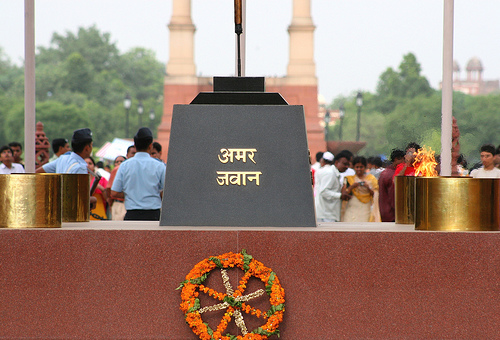
Originally, a Statue of King George V had stood under the now-vacant canopy in front of the India Gate, and was removed to Coronation Park with other statues. Following India's independence, India Gate became the site of the Indian Army's Tomb of the Unknown Soldier, known as the Amar Jawan Jyoti (The flame of the immortal soldier).
The 42-metre tall India Gate is situated such that many important roads spread out from it. Traffic passing around India Gate used to be continuous until the roads were closed to the public due to terrorist threats.
The lawns around Rajpath throng with people during the evening, when the India Gate is lit up. Ice cream and street food vendors come out during this time and it becomes a popular picnic venue for families.

The India Gate hexagon complex covers approximately 306000m² in area with a diameter of about 625m.

Amar Jawan Jyoti

Amar Jawan Jyoti
This cenotaph is itself placed on an edifice which has on its four corners four torches that are perpetually kept alive. It was unveiled in 1971. After the Indo-Pak war of 1971, The then Prime Minister of india Mrs. Indira Gandhi paid homage on behalf of the whole nation on the eve of 23rd republic day (26th january 1972).Burning in a shrine under the arch of India Gate since 1971 is the Amar Jawan Jyoti (the flame of the immortal soldier) which marks the Tomb of the Unknown Soldier. The shrine itself is a black marble cenotaph with a rifle placed on its barrel, crested by a soldier's helmet. Each face of the cenotaph has inscribed in gold the words "Amar Jawan" (Immortal Warrior).
Today, it is customary for the President and the Prime Minister, as well as visiting Guests of State, to pay homage at the site on occasions of State ceremonies.
And specially on each Republic Day, 26 January, the Prime Minister pays homage to the soldiers along with Heads of Armed Forces, before joining the annual parade at the Rajpath, It is noteworthy here that the President of India with the chief guest do not get involved in this ceremony on this day.
The flags represent the 3 Indian military forces (Army, Navy, and Air Force), and a soldier from each force guards the gate and tomb for 24 hours, alternating forces every day.


Saina Nehwal


Saina Nehwal (born March 17, 1990) is an Indian Khel Ratna winning badminton player currently ranked number 3 in the world by Badminton World Federation. Saina is the first Indian woman to reach the singles quarterfinals at the Olympics and the first Indian to win the World Junior Badminton Championships. Saina Nehwal made history on June 21, 2009, becoming the first Indian to win a Super Series tournament, by clinching the Indonesia Open with a stunning victory over higher-ranked Chinese Wang Lin in Jakarta. (The Super Series tournament is roughly equivalent to a Grand Slam in tennis).
Saina won her second career Super Series title by winning the Singapore Open title on June 20, 2010. She completed a hat-trick in the same year by winning the Indonesian Open on June 27, 2010. This win resulted in her rise to 3rd ranking and subsequently to No. 2. Later in the same year she also won Hong Kong Super Series on December 12, 2010.
Previously coached by S. M. Arif, a Dronacharya Award winner, Saina is the reigning Indian national junior champion and is currently coached by Indonesian badminton legend Atik Jauhari since August 2008, with the former All England champion and national coach Pullela Gopichand being her mentor.
Saina was born in Hisar, Haryana and has spent her entire life in Hyderabad, India. Her foray into the world of badminton was influenced by her father Dr. Harvir Singh, a scientist at the Directorate of Oilseeds Research, Hyderabad and her mother Usha Nehwal, both of whom were former badminton champions in Haryana. She is the top ranked player (women) in Indian Badminton history.

Career summary

Saina was the under-19 national champion. Saina created history by the winning the prestigious Asian Satellite Badminton tournament (India Chapter) twice, becoming the first player to do so.
In 2006, Saina appeared on the global scene when she became the first Indian woman to win a 4-star tournament, the Philippines Open. Entering the tournament as the 86th seed, Saina went on to stun several top seeded players including number seed Xu Huaiwen before defeating Julia Wong Pei Xian of Malaysia for the title. The same year also saw Saina as runner up at the 2006 BWF World Junior Championships, where she lost a hard fought match against top seed Chinese Wang Yihan. She did one better in the 2008 by becoming the first Indian to win the World Junior Badminton Championships by defeating ninth seeded Japanese Sayaka Sato 21-9, 21-18.
She became the first Indian woman to reach the quarter finals at the Olympic Games when she upset world number five and fourth seed Wang Chen of Hong Kong in a three-game thriller. In the quarter-finals Saina lost a nail biting 3-gamer to world number 16 Maria Kristin Yulianti. In September 2008, she won the Yonex Chinese Taipei Open 2008 beating Lydia Cheah Li Ya of Malaysia 21-8 21-19. Maria Yulianti had earlier lost her quarter-final match to Pia Bernadet, Saina's semi-final opponent, thus denying Saina a rematch.
Saina has been named The Most Promising Player in 2008. She reached the world super series semifinals in the month of December 2008.
On 21 June 2009, she became the first Indian to win a BWF Super Series title, the most prominent badminton series of the world by winning the Indonesia Open. She beat Chinese Wang Lin in the final 12-21, 21-18, 21-9. Saina on winning the tournament said "I had been longing to win a super series tournament since my quarter final appearance at the Olympics". Saina is on the par with the likes of Prakash Padukone and her mentor Pullela Gopichand who both won the all England championships which are of similar status to the super series. In August 2009 she reached the quarterfinals of world championship losing to the second seed Lin Wang. Saina Nehwal was rewarded with Arjuna award in August, 2009 and her coach Gopichand was also rewarded with Dronacharya award at the same time.
Saina has been signed up by Olympic Gold Quest to support her in fulfilling her dream of winning the Olympic gold medal. Saina has been awarded with Padma Shri award in January 2010. Saina is brand ambassador of Deccan Chargers, an Indian Premier League team owned by Deccan chronicle. She has also became one of the 8 brand ambassadors of 2010 Commonwealth Games held on New Delhi India
Her strategy, at the beginning of 2010, was to ignore ranking points and focus her energies on premier tournaments. That seems to be working as she has won three titles (including two in India), and has reached the semis of two majors. With the World Championships, Commonwealth and Asian Games coming up, her preparation couldn’t have been better. Saina has been awarded with the highest national sporting award given to players, Rajiv Gandhi Khel Ratna award on 29 August 2010.
On October 14, 2010 won gold medal against Wong Mew Choo of Malaysia 19-21, 23-21, 21-13 in CWG Delhi and made an unforgettable moment in India's badminton history.
On December 12, 2010 she won Hong Kong super series defeating Wang Shixian of China 15-21, 21-16, 21-17. Saina Nehwal won 2010 Commonwealth games gold in the women's singles badminton event held in the Siri Fort Auditorium, Delhi, on 14 October 2010.
She was recently voted as the third best Badminton Player of the Year 2010 by readers of an international badminton magazine, Badzine. Lin Dan expectedly won the top spot with 30% votes followed by Lee Chong Wei with 26%, Saina winning 9% in the third place.

Gary Kirsten

Gary Kirsten (born 23 November 1967 in Cape Town) is a former South African cricketer, and the World Cup winning coach of the Indian cricket team. He played 101 Test matches and 185 One-day internationals for South Africa between 1993 and 2004, mainly as an opening batsman. His half brother Peter, also played provincial cricket for Western Province, and then later for the South Africa cricket team which included the highlight of the Cricket World Cup in 1992.

Playing career

Kirsten made his Test debut against Australia in Melbourne in 1993. He retired from international cricket in 2004 after crafting a match-winning 76 in his final innings, against New Zealand. Against the same country he had made history by becoming the first ever Protea to play in 100 Test matches.
Over the years, he gained a reputation as being a sturdy batsman in both Test cricket and one-day cricket. He could up the tempo of an innings if he needed to, but more often than not he simply waited for the bad ball, much like Steve Waugh and Justin Langer. He was also a reliable fielder. Kirsten held the South African records for most runs and centuries in a Test career, before both were surpassed by Jacques Kallis. He was the first Test batsman to make hundreds against each of the other 9 Test nations. He made a score of 275 against England as a result of batting for over 14 and a half hours as South Africa followed on at Kingsmead, still stands as the second-longest innings (in terms of duration) in Test history. The high score was later surpassed by Graeme Smith when he made 277 against England in 2003. He still holds the record for highest innings by a South African in a One Day International; 188 not-out made against the United Arab Emirates during the 1996 World Cup, which is the sixth highest innings of all time in One-Day International cricket, and the highest score in World Cup cricket history.

Coaching career

India (2008-2011)

After retirement, Kirsten organized his own cricket academy in Cape Town. In November 2007, it emerged that Kirsten was a candidate for the vacant post of Indian coach. The BCCI offered him a two-year contract for the post, and despite voicing reservations about concerns he had about having the full support of India players, he confirmed he would be taking the job on 4 December.
He officially started as coach on 1 March 2008. However, he travelled to Australia with India beforehand during the test series. His first full series in charge was against his home country, South Africa in March–April 2008 which was drawn 1-1. Also, he coached India to the finals of the Kitply Cup and 2008 Asia Cup (India lost both the finals). During his tenure as Coach of India, Indian cricket team won a home series against Australia beating them 2-0. Apart from clinching the Border-Gavaskar trophy, he also coached India to its first bilateral series win in Sri Lanka against Sri Lanka and India's first One-Day International series victory against New Zealand in New Zealand after 40 years. India also won the Compaq Cup, defeating Sri Lanka in the finals on 14 September 2009 by 46 runs. A highly accomplished batsman himself, he has brought in a considerable amount of improvement in the batting performances, which is largely associated with his ability to instill better confidence among younger players.
Gary Kirsten has been praised by all players for improving/enhancing their playing techniques, motivating them and discussing tactics that can be deployed on the field. The results could be clearly seen within months. He is considered the key force behind the clearly visible performance improvement in all players. In 2010, Prior to the start of India's tour of South Africa, Indian captain M.S. Dhoni described him as "The best thing to happen to Indian cricket."

Last assignment (2011)

After the tour of South Africa, which India drew 1-1 in the test series lost 3-2 in ODIs, Kirsten announced he would not renew his contract with BCCI because of family commitments, Kirsten often stated that he wanted to spend time with his two growing sons, Joshua and James and wife and three-years away from home was long enough, with Kirsten's contract ending just after the World Cup finishes it is believed that the World Cup will be his last assignment as coach of the Indian national Cricket team. Immediately after the announcement Kirsten was linked with joining South Africa as their coach as the South Africa coach Corrie van Zyl also announced his contract would end after the World Cup as well. Kirsten ended his tenure as coach after India won the 2011 Cricket World Cup defeating Sri Lanka by 6 wickets and 10 balls to spare on 2nd of April, 2011 at Wankhede Stadium in Mumbai, India. During the celebration, he was carried around the ground by Suresh Raina and Virat Kohli to show their respect. His term as coach to the Indian side has come to an end with the Indian team's victory among various media reports of very lucrative offers from various quarters from the cricketing world. But he has cleared the air by adopting a modest approach on his further availabilty as coach to the Indian team by saying that he has no offer and he wanted to say goodbye to India for the reasons that he wants to spend time with his family.